This site is an independent guide to that city, written for the person who is trying to understand it well enough to make a decision: whether to move here, which part of town to look in, what a house on a particular street is likely to cost to run, which district a child would attend, and where the official answer to any of those questions actually lives. It is not a listing service and it sells nothing.
What this guide covers
Riverside is easy to summarise badly. It gets described as a commuter suburb, or as a college town, or as an agricultural relic, and it is genuinely a bit of all three without being fully any of them. The guide is organised around the questions people actually arrive with:
- Relocating to Riverside — what changes when you move inland, from the climate to the commute to the cost of running a household.
- Neighborhoods — how the different parts of the city were built, and what that means for the housing stock you will find in each.
- Searching for a home — how the search process works, what the listing data does and does not tell you, and how to read a property in person.
- Home values — the factors that actually move a Riverside home's value, including several that are specific to California.
- Schools — the districts that serve the city and how attendance boundaries work.
- Utilities — the city-owned electric and water utility, what a summer bill looks like, and the landscape choices that drive it.
- Financing — the mechanics of a mortgage, in order, without the sales pitch.
- Area information — climate, geography, transport and getting around.
- History — how citrus and water built the city, and why that still shows.
- Working with an agent and questions to ask before you hire one — what representation involves and how to evaluate it.
- Helpful links — the official sources, so you can check anything here against the agency that owns the answer.
Riverside at a glance
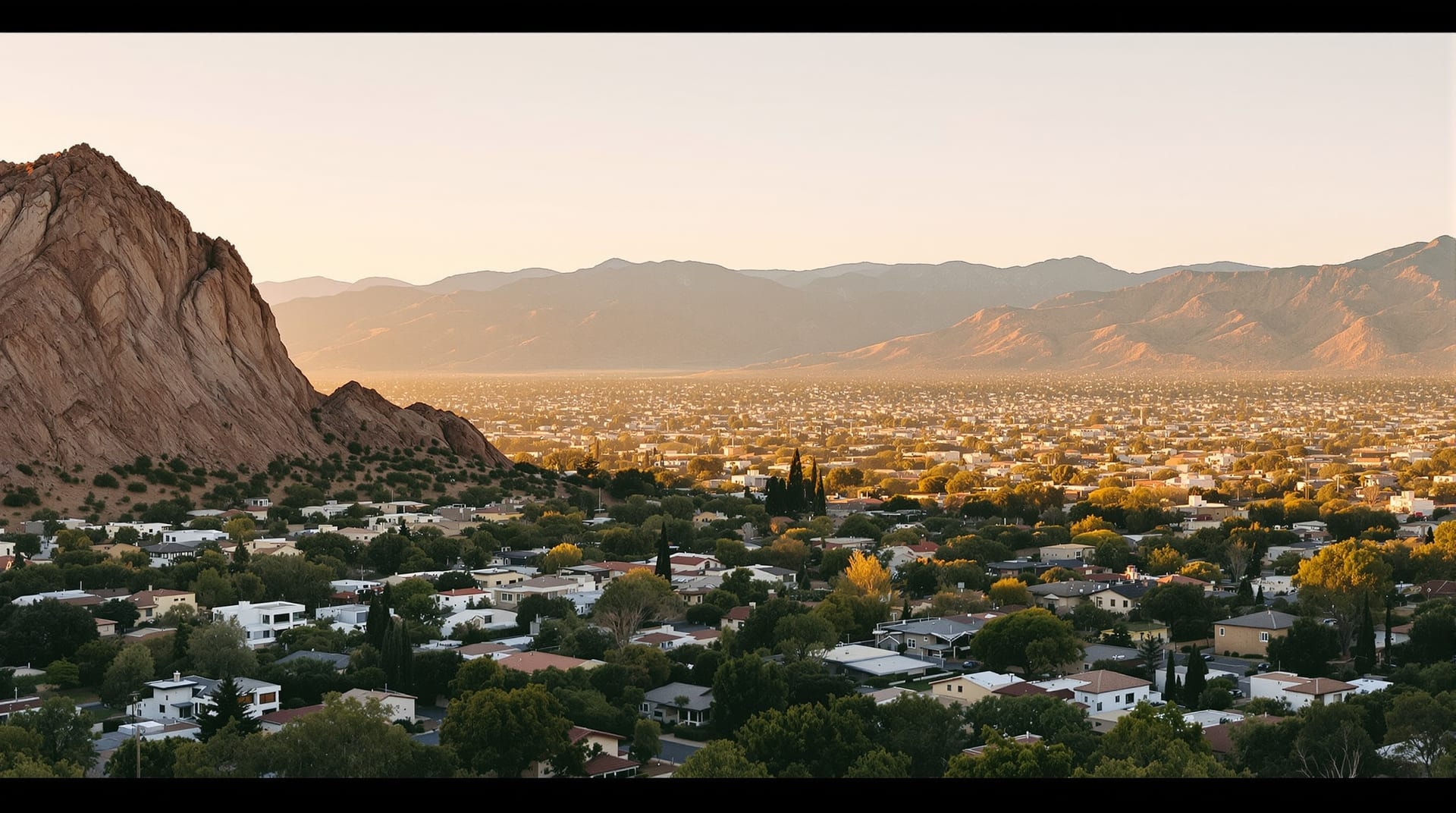
The city occupies a broad valley floor broken up by a handful of steep, rocky hills — Mount Rubidoux on the western edge, Box Springs Mountain to the northeast, the Sycamore Canyon ridges in between. Those hills are why the street grid is not continuous, and why neighborhoods that look adjacent on a map can take fifteen minutes to drive between. The Santa Ana River crosses the northern edge of the city; the flat, fertile ground south and east of it is where the citrus groves went in, and where the largest residential tracts were later built.
The climate is hot-summer Mediterranean shading into semi-arid. Summer afternoons over 100°F are routine rather than exceptional, the humidity is low, and nights cool off more than they do on the coast. Winters are mild, with most of the year's ten or so inches of rain falling between November and March. The practical consequences — for cooling costs, for landscaping, for which rooms of a house are usable in August — run through most of the pages here.
Employment is spread across public institutions, healthcare, logistics, education and county government rather than concentrated in one industry. A significant share of residents commute west toward Orange and Los Angeles counties, and that commute is the single most consequential lifestyle variable for anyone moving here from the coast. It is covered in detail on the area information page.

How to use what follows
Every page here is written to be read on its own, and every page points at the public agency that holds the authoritative version of what it describes. Where a fact is administrative — a district boundary, a tax assessment, a permit requirement, a utility rate — the guide explains how the mechanism works and then sends you to the agency, because those details change and this site does not track them.
For anything official about the city itself, the City of Riverside publishes its own resident information, including neighborhood profiles and homeownership assistance programs. County-level records — assessments, deeds, recorded documents — sit with the County of Riverside. Statewide housing and licensing questions belong to the relevant state department, and those are linked from the pages that raise them.
Independent, not official
Home in Riverside is an independent editorial reference. It is not affiliated with, endorsed by, or operated by the City of Riverside, the County of Riverside, any school district, any utility, or any real estate brokerage, agent or listing service. It does not represent buyers or sellers, does not accept listings, and has nothing to sell. Nothing on this site is legal, tax, financial or real estate advice; for advice about a specific property or a specific transaction, consult a licensed professional and the relevant public agency.
That independence is the point of the site. A guide that is trying to win your business has to be read differently from one that is not, and everything here is written on the assumption that you will go and check it.